
Most financial terms get explained in ways that make them sound more complicated than they are. Primary vs secondary market is one of them, two straightforward concepts that get tangled in jargon the moment most explanations begin.
Here is the short version – the primary market is where securities are born; the secondary is where they spend the rest of their lives. That distinction answers the core question, but not why it matters or how each one actually works.
I’ve spent enough time in financial content to know this confusion is more common than people admit. This guide covers both markets properly, definitions, mechanics, real examples, and how to decide which one suits your investment goals.
Understanding Financial Markets
Financial markets are organized systems in which buyers and sellers come together to trade assets, such as stocks, bonds, currencies, and other financial instruments. They exist to connect those who have capital and want to grow it with those who need capital and want to raise it.
Understanding different market types matters because every investment decision takes place within a specific market structure that determines how prices are set, who you’re transacting with, and where the money actually goes.
At the broadest level, financial markets split into two categories: the primary market and the secondary market. These are two sequential stages every security passes through, one in which it is created and sold for the first time, the other in which it is subsequently traded between investors.
What is the Primary Market?
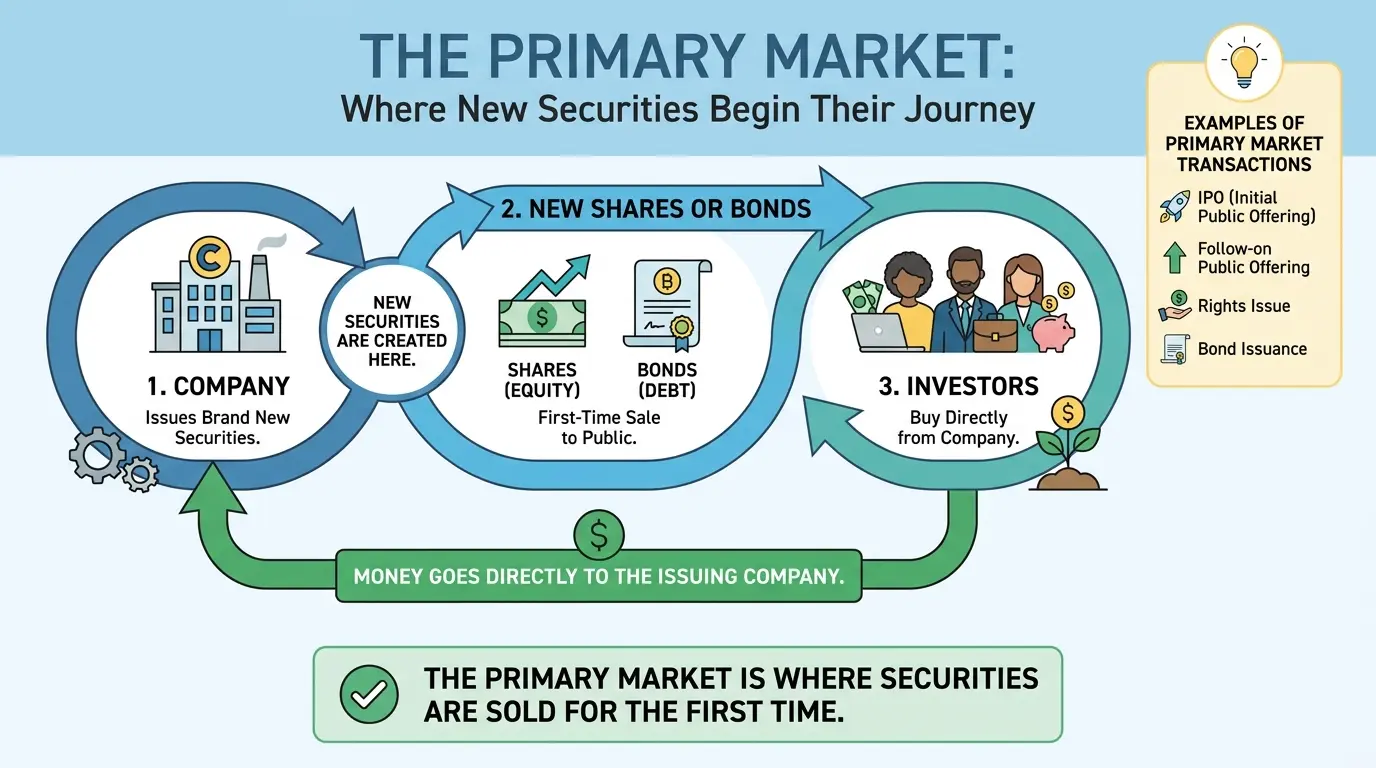
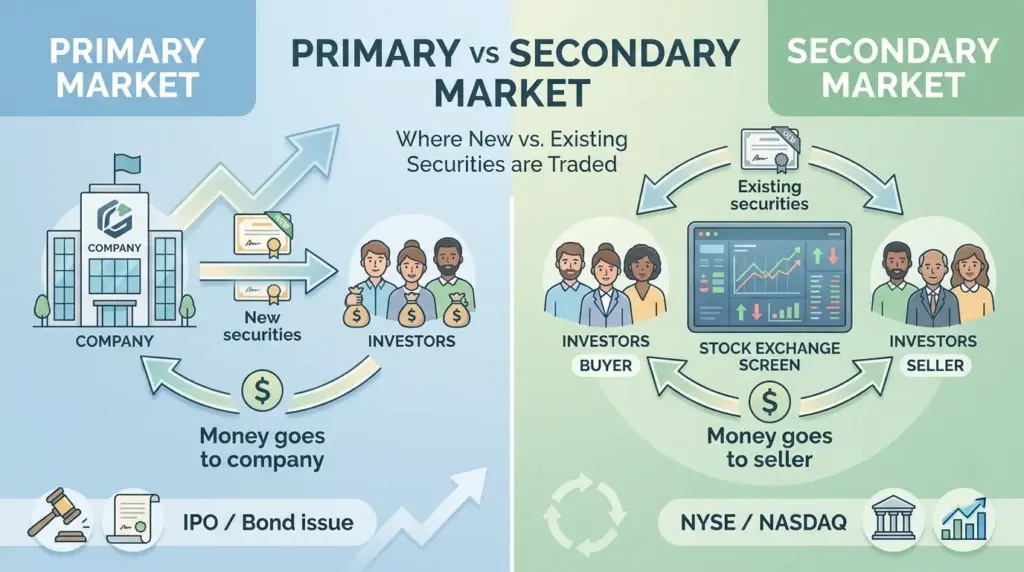
The primary market is where securities are created and sold for the very first time. When a company needs to raise capital, it issues new stocks or bonds and sells them directly to investors.
The money paid goes directly to the issuing company or government, not to any other investor. In the US, this process is regulated and overseen by the Securities and Exchange Commission (SEC).
Key Characteristics:
- First point of issuance: Every stock or bond that exists today passed through a primary market first.
- Direct transaction: The issuing company deals directly with investors. No stock exchange is involved in the initial sale.
- Capital goes to the issuer: All funds raised go directly to the company or government that issued the security.
How Does the Primary Market Work?
- The company identifies a capital need, such as expansion, new projects, or debt repayment
- Appoints an investment bank like Goldman Sachs or Morgan Stanley to underwrite the issuance
- Files a registration statement and prospectus with the regulatory approval.
- Price is set through a fixed-price or book-building process based on investor demand
- Securities go live to institutional and retail investors through brokerage platforms
What is the Secondary Market?
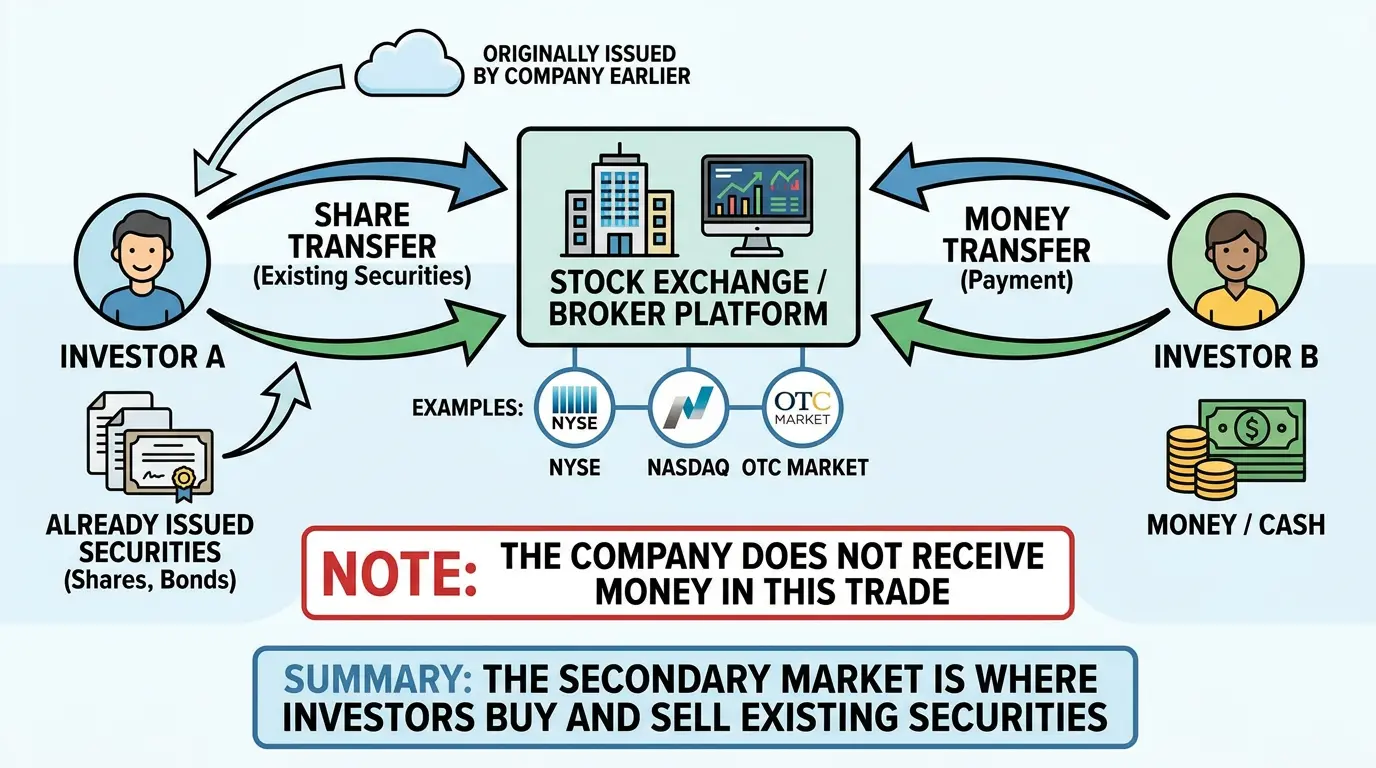
The secondary market is where previously issued securities are bought and sold between investors. This is what most Americans mean when they talk about “the stock market.” Exchanges like the NYSE and NASDAQ are the most recognized secondary markets in the world.
The issuing company is no longer part of the transaction; securities change hands at prices determined purely by market forces. The issuer receives no proceeds regardless of how many times the security changes hands.
Key Characteristics:
- Previously issued securities: Every security traded here was first issued in the primary market.
- Investor-to-investor transactions: The original issuing company plays no role once trading begins.
- Price determined by market forces: Prices fluctuate based on supply, demand, and investor sentiment.
How Does the Secondary Market Work?
- An investor places a buy or sell order through a brokerage platform like Fidelity or Charles Schwab
- Order is matched on the exchange, major US exchanges, in real time
- Price is determined by supply and demand at that exact moment
- Trade executes and settles within one to two business days
- Proceeds go directly to the selling investor, not the original issuer
Primary vs Secondary Market: Key Differences
The definitions establish what each market is, but the differences between them go beyond that. Here is exactly how they compare across every factor that matters to a US investor.
| Factor | Primary Market | Secondary Market |
|---|---|---|
| Purpose | Raise capital for the issuer | Provide liquidity for investors |
| Proceeds go to | Issuing company or government | Selling investor |
| US Examples | IPO, FPO, Treasury bond issuance | NYSE, NASDAQ, OTC markets |
| Risk level | Moderate, fixed entry price | Higher prices fluctuate constantly |
| Frequency | One-time per security | Continuous trading |
| Regulation | Heavily regulated by the regulatory approval | SEC-regulated but more market-driven |
| Liquidity | Lower, limited to the issuance window | High, trade anytime during market hours |
Types of Primary Market Instruments
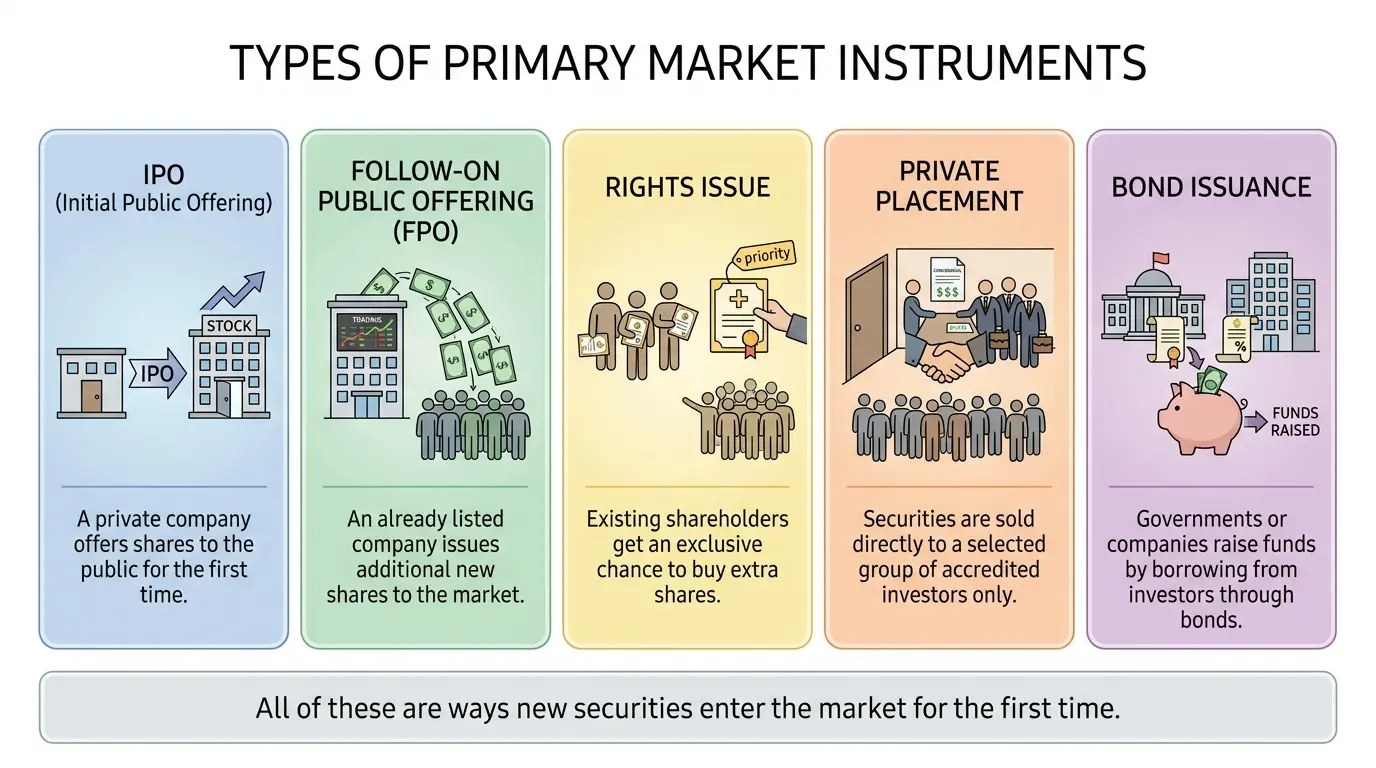
Not every primary market transaction looks the same. Here are the most common instruments through which securities are first issued in the US.
- IPO: A private company offers shares to the public for the first time on major US exchanges, raising capital directly from new shareholders.
- Follow-on Public Offering (FPO): A listed company issues additional shares to raise fresh capital, diluting existing shareholders in the process.
- Rights Issue: Existing shareholders get the right to purchase additional shares at a discounted price before the general public.
- Private Placement: Securities sold directly to accredited investors under SEC Regulation D with fewer disclosure requirements.
- Bond Issuance: The US government issues bonds via TreasuryDirect. Corporations issue bonds directly to investors at fixed interest rates.
Each instrument serves a different capital-raising purpose; knowing which one applies makes following financial news significantly more straightforward.
Types of Secondary Market Instruments
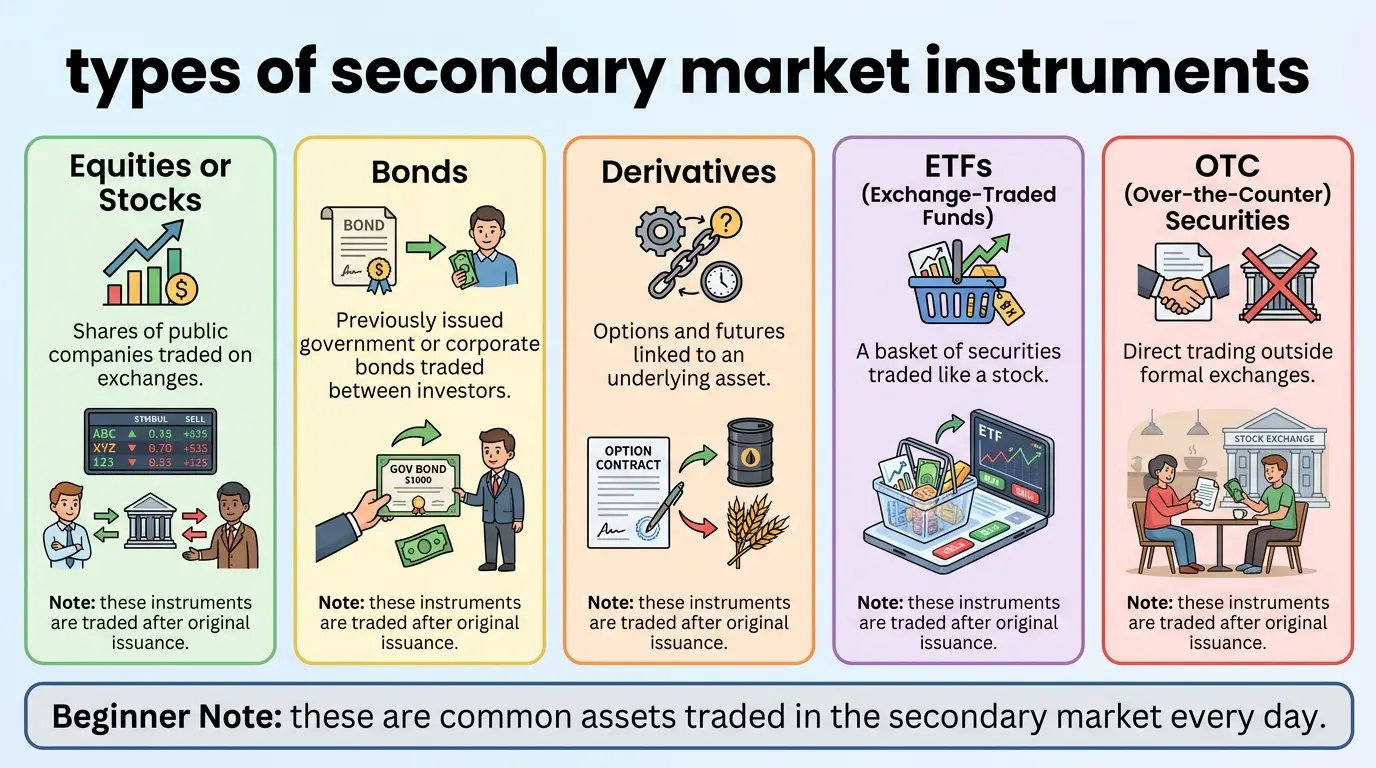
Once securities leave the primary market, trading begins and never stops. Here are the most actively traded instruments in the US secondary market.
- Equities (Stocks): Shares of publicly listed US companies change hands continuously on the major US exchanges throughout every trading day.
- Bonds: Previously issued US Treasury and corporate bonds trade in the secondary market, allowing investors to exit positions before maturity.
- Derivatives: Options and futures contracts traded on exchanges like the Chicago Mercantile Exchange (CME), deriving value from an underlying asset.
- ETFs: Baskets of securities created in the primary market that subsequently trade on exchanges like individual stocks.
- OTC Securities: Smaller company stocks and certain bonds trade directly between parties outside formal exchanges through OTC markets.
Understanding these instruments explains the daily volume and activity reported across US financial markets.
How Primary and Secondary Markets Work Together
Most investors interact with one market at a time, but the two are fundamentally connected in ways that determine how capital flows through the entire US financial system.
The connection starts at the IPO. When a company lists on the major US exchanges, it raises capital directly from investors in the primary market. The moment that the offering closes, those same securities move into the secondary market, where they trade freely between investors going forward.
Investors participate in the primary market precisely because the secondary market provides an exit. Without that liquidity, far fewer investors would commit capital at issuance.
The relationship works both ways; rising secondary markets encourage more IPO activity, while declining markets significantly slow primary issuances.
One market creates capital. The other sustains it. Neither functions properly without the other.
Who Participates in Each Market?
Both markets involve investors, but participants and their level of access differ significantly between the two.
Primary Market:
- Issuing companies and the US government: creating and selling securities for the first time
- Investment banks: firms like Goldman Sachs, managing the issuance process
- Institutional investors: mutual funds and pension funds receive priority access
- Retail investors: participating through IPO applications on platforms like Fidelity
- The SEC: Overseeing every primary market issuance
Secondary Market:
- Retail investors: the largest participant group, trading daily through brokerage accounts
- Institutional investors: largest by volume, executing trades on behalf of funds
- Brokers and dealers: facilitating transactions between buyers and sellers
- Market makers: providing continuous liquidity across exchanges
- Hedge funds: actively seeking short-term price inefficiencies
Understanding who participates clarifies why access, pricing, and transaction dynamics feel so different between the two.
Importance of Primary and Secondary Markets
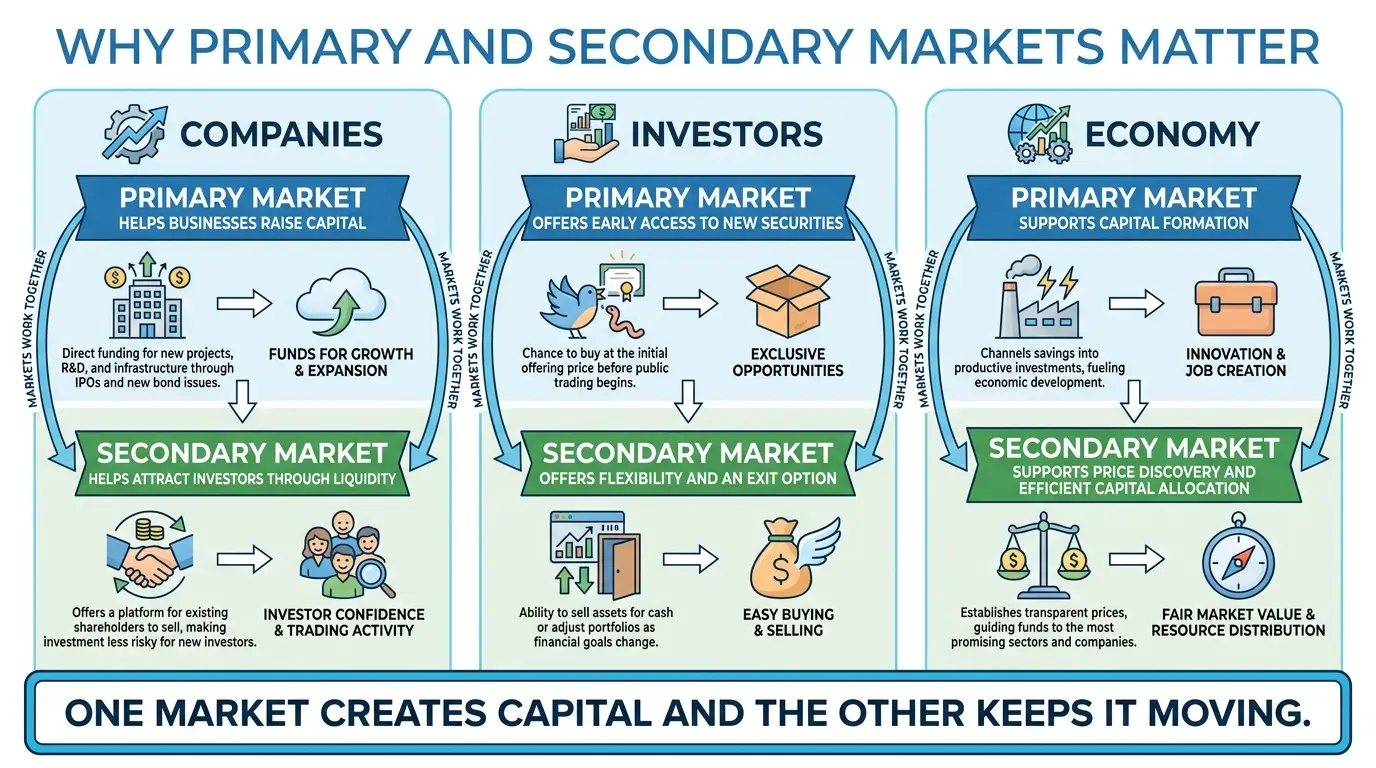
Both markets serve purposes that extend well beyond individual transactions; they are the foundation of how capital moves through the US economy.
Importance for Companies
Primary and secondary markets give companies direct access to the capital they need to grow. The primary market allows businesses to raise funds from public investors without taking on debt, financing expansion, acquisitions, and research at scale.
The secondary market matters equally; a liquid market for a company’s shares makes it easier to attract investors, retain employees through stock compensation, and build long-term shareholder value. Without both markets functioning effectively, corporate fundraising would be significantly slower and more expensive.
Importance for Investors
For investors, these markets represent the full spectrum of investment opportunities. The primary market offers early access to new securities at fixed prices, a chance to invest before open-market trading begins. The secondary market provides what matters most after that initial purchase: liquidity and the freedom to exit.
Investors can buy and sell on their own timeline, respond to changing financial circumstances, and build diversified portfolios across multiple asset classes, all made possible by continuous secondary market trading.
Importance for the Economy
At the macroeconomic level, primary and secondary markets are the engine of capital formation in the US economy. The primary market channels investor funds directly into productive business activity, creating jobs, funding innovation, and driving growth.
The secondary market ensures price efficiency; securities are continuously repriced based on new information, keeping capital flowing toward its most productive uses. Together, they create the infrastructure that allows the US economy to allocate resources efficiently across industries and over time.
Pros and Cons of Primary
| ✅ Pros | ❌ Cons |
|---|---|
| Fixed entry price reduces initial risk | Limited access, not all offerings are public |
| Transparent regulatory approval process | Oversubscription means no guaranteed allotment |
| Early investment opportunity at issuance | Limited participation window |
| Direct capital access for companies | Less liquidity immediately post-issuance |
Pros and Cons of Secondary Markets
| ✅ Pros | ❌ Cons |
|---|---|
| High liquidity, buy and sell anytime | Higher price volatility |
| Continuous price discovery through trading | Susceptible to market manipulation |
| Wide range of instruments available | Brokerage and transaction costs apply |
| Flexible investment timeline | Requires active monitoring |
Both markets carry trade-offs; the right choice depends entirely on your investment goals, risk tolerance, and timeline, rather than one being objectively better than the other.
Misconceptions About Primary and Secondary Markets
These misunderstandings are widespread, even among experienced investors. Clearing them up changes how you read financial news entirely.
- The secondary market funds companies directly: When you buy Apple shares on the NYSE, Apple receives nothing. The money goes to the selling investor companies, which receive funds only at the initial issuance.
- An IPO is part of stock market trading: An IPO is a primary market transaction. Applying for an IPO and buying shares after listing are fundamentally different activities.
- Higher trading volume benefits the issuing company: It does not. Volume only affects the stock price, never the company’s cash position directly.
Recognizing these misconceptions separates investors who understand market mechanics from those who only understand the surface.
Real-World Examples
Primary Market Example: Meta’s IPO
When Facebook, now Meta, went public in May 2012, it issued shares for the first time at a fixed price of $38 per share on NASDAQ. Investors who applied during the IPO were participating in the primary market.
The $16 billion raised went directly to Meta and its early shareholders, not to any exchange or intermediary. That single transaction remains one of the largest IPOs in US history.
Secondary Market Example: Trading Meta Shares Post-IPO
The moment Meta’s shares began trading on NASDAQ after the IPO closed, every subsequent transaction was a secondary-market trade.
An investor buying Meta shares today through Fidelity, Schwab, or Robinhood is participating in the secondary market, paying another investor, not Meta itself. Meta receives nothing from those trades regardless of the price.
Bond Example: US Treasury Bonds
When the US government issues Treasury bonds through TreasuryDirect, that is a primary market transaction; funds go directly to the government.
When an investor later sells those Treasury bonds to another investor through a brokerage before maturity, that is a secondary market transaction; the government receives nothing from the exchange.
Final Thoughts
I see financial markets feel simpler once the core idea is clear, rather than wrapped in jargon. You now know how new securities are issued in one system and traded in another.
The primary vs secondary market difference helps you see where money flows and who benefits. This understanding supports better decisions when you invest or follow market news. It also prevents confusion between buying shares at issue and later trading them.
Share what part feels most confusing, or check related guides on investing basics to strengthen your understanding, apply it in real situations, improve how you approach future investment decisions, and keep learning step by step.