

I’ve spent years watching traders chase complex strategies, hoping to strike it rich overnight. But what if I told you there’s a simpler path to consistent income?
Let me introduce you to the Wheel Strategy: a systematic, cash-secured approach that combines selling puts and covered calls to generate steady returns.
Think of it as getting paid while you wait to buy stocks you already want to own, then getting paid again while you sell them.
I’m going to break down exactly how this strategy works, show you the market conditions where it truly shines, help you understand what kind of returns you can realistically expect, and most importantly, reveal the risks you need to watch out for.
The Wheel might just become your favorite way to generate income from options.
What is the Wheel Strategy in Options?
The Wheel Strategy is a three-phase options income approach that I find beautifully simple.
Here’s how it works: I start by selling cash-secured puts on stocks I’m willing to own. If the stock price drops and I get assigned, I take ownership of those shares.
Then comes phase three; I sell covered calls against my shares, potentially selling them at a profit while collecting premiums along the way.
The goal isn’t just speculation; it’s about generating steady premium income while possibly accumulating quality stocks at a discount.
Long-term investors and income-focused traders love this method.
You might also hear it called other names like “Triple Income Strategy” or “Put-to-Call Wheel”, same concept, different names.
How the Wheel Strategy Works (Step-by-Step)
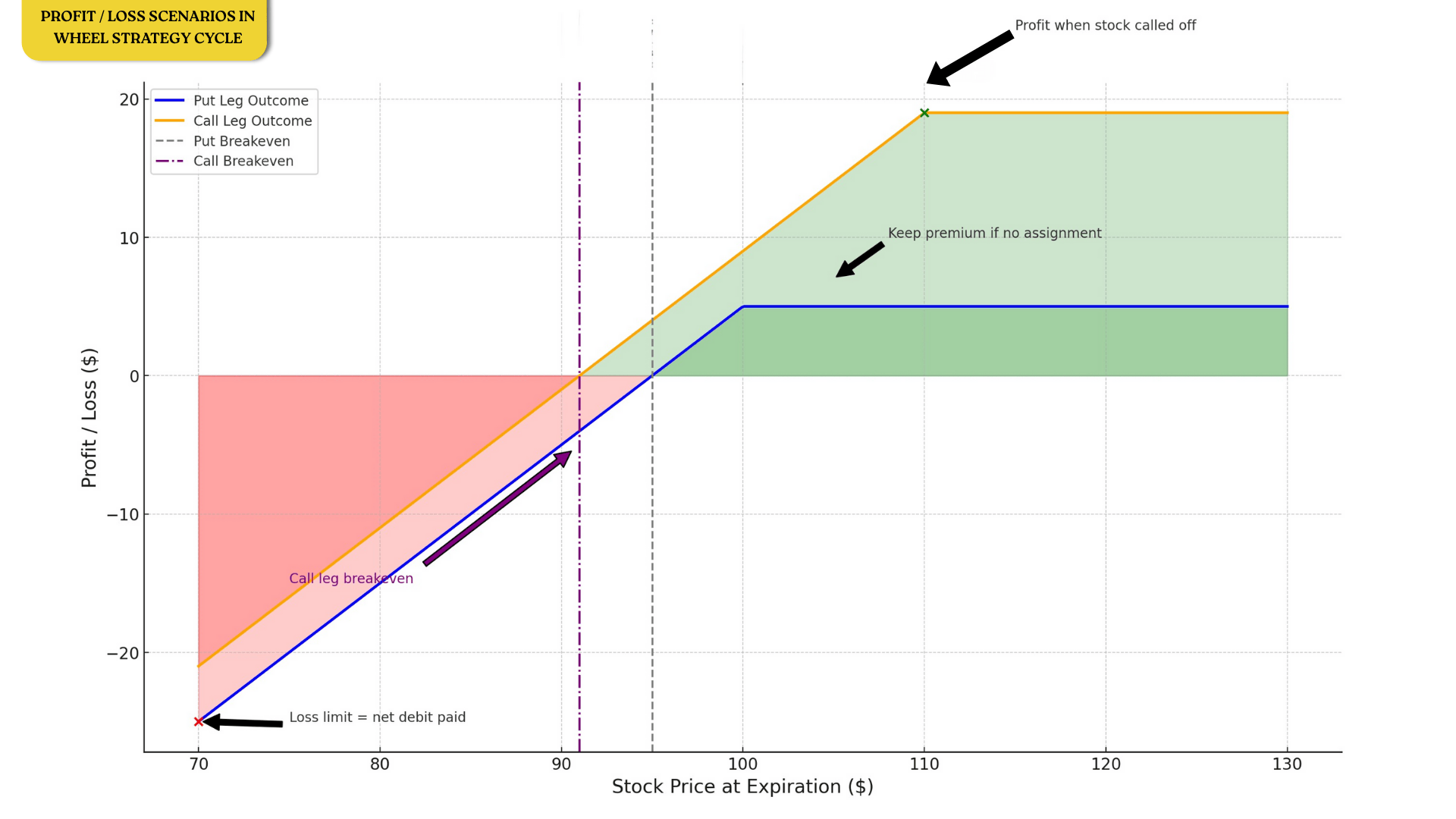
The Wheel Strategy gets its name from its cyclical nature; once you complete all three steps, you simply start over again.
Let me break down each phase so you can see exactly how the money flows.
Step 1: Sell Cash-Secured Puts
I kick things off by selling an out-of-the-money put option on a stock I genuinely want to own. This means I’m getting paid upfront just for agreeing to buy the stock at a lower price.
If the stock stays above my strike price by expiration, I pocket the entire premium and walk away. But if the stock drops below that strike, I’m obligated to buy shares at the agreed-upon price.
This isn’t a bad thing; I wanted to own the stock anyway, and now I’m buying it at a discount while keeping the premium I collected.
Timeframe: Typically weekly to monthly expiration cycles.
Risk Advice: Never sell puts on stocks you wouldn’t actually want to hold long-term. If the company is fundamentally weak, no premium is worth getting stuck with worthless shares.
Step 2: Own the Stock
Now I’m holding shares of the underlying stock. This is the quietest phase of the strategy, but it’s not idle time.
While I wait to move into the next step, I might collect dividends if the company pays them. My shares are sitting in my account, and I’m already planning my next move.
The key here is patience; I’m not panicking about short-term price movements because I have a plan to continue generating income from these shares.
Timeframe: Immediate assignment after put expiration, holding period varies.
Risk Advice: If the stock drops significantly below your purchase price, don’t panic-sell. Continue selling covered calls to lower your cost basis, or consider rolling down your strikes if the decline is severe.
Step 3: Sell Covered Calls
Here’s where the strategy really shines. I sell out-of-the-money call options against my shares, collecting another round of premium.
If the stock rallies above my call strike price, my shares get called away, meaning they’re sold at a profit. If the stock stays below the strike, I keep the premium and my shares, then sell another covered call.
Once my shares are called away, I’m back to square one with cash in hand, ready to sell puts again. The wheel keeps spinning.
Timeframe: Weekly to monthly, repeating until shares are called away.
Risk Advice: Don’t get greedy by selling calls too close to the current price just for higher premiums. Give your shares room to appreciate, or you’ll constantly sell winners too early and hold losers too long.
Example of the Wheel Strategy in Action
Let me show you how this plays out in real life. I’ll use a straightforward example with a stock trading at fifty dollars to illustrate each phase and the potential outcomes.
Here’s how the wheel spins:
- Starting Position: XYZ stock is trading at $50, and I’m comfortable owning it. I sell a cash-secured put with a $47.50 strike price and collect $1.00 in premium per share. My account is credited immediately.
- Assignment Happens: The stock drops to $47, and I’m assigned. Now I own 100 shares at my strike price of $47.50, but my effective cost basis is actually $46.50 because I already pocketed that dollar premium.
- Switching to Calls: With shares in hand, I sell a $50 covered call and collect another $1.00 premium. I’m now waiting to see what happens at expiration.
- Three Possible Outcomes: If XYZ stays below $50, I retain my shares and the premium, then I sell another call. If it rises above $50, my shares get called away at a profit. If it tanks, I need to decide whether to hold, roll my position, or accept the paper loss while continuing to sell calls.
- The Wheel Completes: Once my shares are called away, I’ve collected premiums twice and potentially made capital gains. Now I’m back to selling puts, and the cycle starts fresh.
This is the beauty of the Wheel; I’m getting paid at every turn, and I’m only dealing with stocks I actually want to own.
Risk Advice: This example assumes XYZ is a solid company. If the stock crashes to $30 after assignment, those two dollars in premiums won’t save me from a significant loss. Always stress-test your positions: can I handle a 20-30% decline?
Key Components of the Wheel Strategy
Getting the fundamentals right makes all the difference between a smooth-running wheel and a bumpy ride. Let me break down the critical elements I focus on every time I set up a position.
| Component | What I Look For | Recommended Range | Why It Matters |
|---|---|---|---|
| Underlying Stock Selection | Liquid stocks with strong fundamentals and moderate volatility | Blue-chips or stable growth stocks | I need companies I’m happy to own. High liquidity ensures tight spreads and easy exits. |
| Strike Price Selection | Out-of-the-money for safety, closer to at-the-money for a higher premium | 0.20–0.40 delta range | Further OTM reduces assignment risk; closer to ATM increases income potential. |
| Expiration Dates | 30–45 days out | 4–6 weeks typically | Maximizes theta decay in the sweet spot without locking up capital too long. |
| Position Sizing | Full cash collateral is ready | Never exceed buying power | Ensures I can handle the assignment without margin calls or forced selling. |
Insider tip: Never allocate more than 5-10% of your total portfolio to a single wheel position. Concentration risk is real, and one bad stock can wipe out months of premium income.
Advantages of the Wheel Strategy
Here’s why I keep coming back to the Wheel Strategy, even when there are flashier options out there. These benefits make it one of the most reliable income generators in my trading toolkit.
- Consistent Premium Income: I collect premiums regularly in neutral to mildly bullish markets, generating a steady cash flow without relying on dramatic price movements.
- Discounted Stock Acquisition: When I am assigned, I buy quality stocks at a discounted market price. I’m essentially getting paid to own companies I already wanted.
- Lower Cost Basis over Time: Every premium I collect reduces my effective purchase price, making my positions more profitable even if the stock stays flat.
- Semi-Passive Income Stream: Once I set up my positions, the strategy runs itself with minimal daily monitoring. Ideal for traders who prefer not to be glued to screens.
The beauty of these advantages is that they stack on top of each other. I’m not just picking one benefit; I’m combining all of them to build wealth steadily.
Risks and Drawbacks of the Wheel Strategy

No strategy is perfect, and the Wheel has its share of challenges. I’ve learned to respect these risks because ignoring them can turn a solid income strategy into a losing proposition fast.
- Downside Risk: If the stock crashes after assignment, my premium won’t cover the losses. I’m stuck holding underwater shares.
- Capped Upside: Selling covered calls means I miss out on explosive rallies beyond my strike price.
- Assignment Risk: Early assignment can happen before dividends or during volatility spikes, disrupting my planned cycle.
- Capital-intensive: I need substantial cash reserves for each position, limiting how many wheels I can run simultaneously.
The key is accepting these limitations upfront. I’m not trying to hit home runs here; I’m building a base of steady income while being honest about what can go wrong.
Ideal Market Conditions for the Wheel Strategy
The Wheel doesn’t work equally well in every market environment. Knowing when to deploy this strategy and when to sit on the sidelines can make or break your results.
| Market Condition | Wheel Performance | Why |
|---|---|---|
| Sideways/Rangebound | Excellent | Premiums get collected repeatedly without assignment risk. Stock stays in a predictable range. |
| Moderately Bullish | Very Good | I capture premium income plus potential capital appreciation. Shares may get called away at a profit. |
| High Volatility | Challenging | Wild price swings increase assignment risk and make it harder to select appropriate strikes. |
| Strong Downtrend | Poor | Stock keeps falling after assignment, creating mounting losses that premiums can’t offset. |
| Best Stock Types | Blue-chip stocks or ETFs | Stability matters more than excitement. Think SPY, QQQ, or established companies with solid fundamentals. |
Risk Warning: I never run the Wheel during earnings season or major economic announcements unless I’m prepared for assignment. Volatility spikes can turn a controlled strategy into a chaotic mess. Always check the calendar before selling options.
Managing & Rolling Positions
The real skill in the Wheel Strategy isn’t just starting the cycle; it’s knowing when and how to adjust when things don’t go according to plan.
These management techniques have saved me from countless losing positions.
Rolling Strategies: When to Adjust Your Options
I roll my options when it makes financial sense to extend my position rather than close it. For puts, if the stock is hovering near my strike at expiration and I don’t want assignment yet, I’ll roll out to a later date for additional credit.
For calls, I evaluate whether the stock will keep climbing or if it’s hitting resistance. If I’m underwater on my shares and my call is about to expire worthless, I immediately sell another one rather than waiting.
The key question I ask: Can I collect more premiums by rolling than by closing and starting fresh?
Risk Advice: Only roll for a net credit, never a debit. If you’re paying to extend a losing position, you’re likely better off taking the loss and moving on. Rolling indefinitely on a collapsing stock just digs a deeper hole.
Tracking Performance: Know Your Real Returns
I obsessively track my cost basis after every premium collection because it’s the only way to know if I’m actually making money.
If I bought shares at $47.50 and collected $1 from the put plus $1.50 from two covered calls, my real cost basis is $45. That’s what matters for calculating my return, not the original strike price.
I also measure my return on collateral; if I’m tying up ten thousand dollars to make three hundred in premiums monthly, that’s a 3% monthly return on capital deployed.
This math tells me whether the Wheel is outperforming my other investment options.
Risk Advice: If your cost basis keeps rising because you’re rolling losing positions for debits or the stock keeps tanking, stop fooling yourself with mental accounting. Face the loss, exit the position, and preserve your capital for better opportunities.
Taxes, Costs & Realistic Returns
Here’s what I actually take home after all the deductions. Every premium I collect gets taxed as short-term capital gains at my ordinary income rate, which can be 22% to 37% depending on my bracket.
In calm markets, I typically earn 2–4% per monthly cycle, translating to roughly 15–30% annualized returns.
That sounds great until I factor in commissions on every option trade and bid-ask spreads that can eat 10–20% of my premium on less liquid tickers.
My rule of thumb: calculate net returns after taxes and costs, not gross premiums. The Wheel is profitable, but the real numbers are more modest than the hype suggests.
Comparison: Wheel Strategy vs. Other Income Strategies
I get asked all the time how the Wheel stacks up against other income strategies. Here’s how I see the landscape when choosing which approach fits my goals and market outlook.
| Strategy | Description | Best For | Capital Required | Risk Profile |
|---|---|---|---|---|
| Wheel Strategy | Cycles between cash-secured puts and covered calls | Long-term income with flexibility | High (full collateral needed) | Unlimited downside risk on the stock |
| Covered Calls | Sell calls against owned shares | Bullish-neutral, existing holdings | Very High (must own 100 shares) | Capped upside, unlimited downside |
| Cash-Secured Puts | Sell puts to acquire stock | Stock accumulation at a discount | High (strike × 100 in cash) | Assignment risk if the stock drops |
| Iron Condor | Simultaneous call and put spreads | Range-bound markets | Low to Moderate | Defined max loss at both wings |
Each strategy has its place, but I lean toward the Wheel because it adapts to what the market gives me. I’m not locked into one phase; I’m flowing between puts and calls based on whether I own shares or not.
The capital intensity is real, but so is the flexibility to profit in multiple scenarios.
The Bottom Line
The Wheel Strategy has become one of my most dependable tools for generating income while building positions in solid companies. It’s methodical, it’s repeatable, and it works when I stick to the fundamentals.
But let me be clear: this isn’t a get-rich-quick scheme or some magical formula that eliminates risk.
I need discipline to choose the right stocks, patience to let the cycle complete, and solid risk management to avoid blowing up my account.
My advice? Start with just one stock or ETF you genuinely believe in. Track every trade, measure your results honestly, and adjust as you learn what works for your style and capital.
What’s your experience with the Wheel Strategy? Drop a comment below and let me know which stocks you’re wheeling or what challenges you’ve faced.