
Markets rarely move in a straight line, and that’s something I’ve noticed across years of studying price action and live trades. When looking at futures vs options, confusion usually begins at one point: how one contract locks in an obligation while the other gives a choice, and how that difference changes risk as the price moves.
You may have felt that uncertainty when a position starts shifting faster than expected, and decisions feel less obvious. The breakdown here focuses on how both instruments actually function, how gains and losses build, and where traders often misread exposure.
The aim is simple – bring clarity that holds up in real trading situations, so the structure behind both becomes easier to read and apply.
What are Derivatives: Where Do Futures and Options Fit?
Before understanding futures and options individually, you need to understand what fundamentally connects them.
Both are derivatives, financial contracts whose value is derived entirely from an underlying asset, such as a stock, commodity, currency, or index.
They have no intrinsic value; they simply track something else. The broader derivatives family includes forwards, swaps, and warrants, but futures and options are the two most actively traded, most regulated, and most accessible derivatives available to everyday retail traders in the US market today.
Think of derivatives as the umbrella, and futures and options as the two most powerful, most widely used, and best-understood tools sitting directly underneath it.
What are Futures Contracts?
A futures contract is a standardized agreement to buy or sell a specific asset at a predetermined price on a set future date. Both buyer and seller are legally obligated to fulfill it.
All US futures trade on regulated exchanges like the Chicago Mercantile Exchange (CME), which sets fixed contract sizes, expiry dates, and settlement terms; you cannot negotiate or customize any terms privately.
Key Features of Futures:
- No ownership required: you never need to hold the underlying asset at any point
- Two settlement types: commodity contracts risk physical delivery; financial contracts settle in cash only
- Near 24-hour trading access: electronic platforms cover most major global markets continuously
How Futures Work
- Choose your asset: commodities (oil, gold), stock indices (S&P 500), or currencies
- Agree on a price: locks in today’s price for a future settlement date
- Deposit margin: post 5%–10% of the total contract value as collateral
- Daily mark-to-market: gains and losses credited or debited to your account every evening
- Close or settle: exit before expiry or settle via cash or physical delivery
What are Options Contracts?
An options contract gives the buyer the right, but not the obligation, to buy or sell an asset at a specific price (strike price) before or on a set expiry date.
The buyer pays a premium upfront to hold this right. If the trade isn’t profitable at expiry, the buyer simply walks away, losing only the premium paid, nothing beyond that.
Key Features of Options:
- Implied volatility impacts pricing: high volatility inflates premiums, meaning you can overpay even when directionally correct
- Multiple strikes and expiry dates: far more strategic entry points than futures ever allow
- Exclusive income generation: selling covered calls and cash-secured puts is entirely unavailable in any futures market
How Options Work
- Pay the premium: your upfront cost and the maximum you can ever lose as a buyer
- Choose a strike price: the price at which you hold the right to buy or sell
- Wait for price movement: the asset needs to move in your favor before expiry
- Exercise, sell, or let it expire: profit by exercising or selling the contract, or let it expire worthless.
Futures vs Options: Key Differences That Actually Matter
Futures and options share the same markets but behave in completely opposite ways. Understanding these differences isn’t optional; it’s what separates traders who survive from those who don’t.
1. Obligation vs Right: The Core Difference
Futures bind both the buyer and seller to complete the trade at expiry, no exceptions allowed. Options give the buyer a clear choice: act if it’s profitable, simply walk away if it’s not.
The seller in an options contract remains obligated regardless of the buyer’s final decision. This asymmetry is what fundamentally changes how risk is distributed between the two parties.
2. Linear vs Nonlinear Profit Behavior
With futures, every $1 move in the underlying asset produces a fixed, predictable dollar gain or loss, a perfectly straight line. Options behave quite differently: profits accelerate as the trade moves further in your favor due to the Gamma effect.
This nonlinear payoff means options can return multiples of the initial investment when a large, fast market move occurs.
3. Time Decay: The Silent Cost of Holding Options
Futures don’t decay; holding a position costs nothing extra as time passes. Options do the opposite: they lose value every single day through Theta, even when the underlying asset stays completely flat.
A trader can be correct on market direction and still lose money on options simply because the anticipated move arrived too late. Time is always working against the options buyer.
4. Contract Size: What You’re Actually Controlling
One E-mini S&P 500 futures contract has a notional value of roughly $275,000, which can be intimidating for most retail traders. One standard options contract (100 shares, US) might cost just $200–$500 in premium.
The underlying exposure remains real and meaningful, but the capital required to enter is dramatically lower with options, making them significantly more accessible to individual traders with smaller accounts.
5. Leverage: Margin-Based vs Premium-Based
Futures leverage is margin-based: you deposit ~$12,000–$20,000 to control a $275,000 contract. Leverage of 15:1 or higher. Options leverage is premium-based: a $200 call option can control $15,000 worth of stock.
Options buyers cannot receive a margin call; your maximum loss is strictly the premium paid. Futures traders have no such protection, making leverage management critical.
Quick Reference Table for Futures vs Options
| Difference | Futures | Options |
|---|---|---|
| Core obligation | Both parties must fulfill | The buyer has the right only |
| Upfront cost | Margin deposit (~$12k–$20k) | Premium paid ($200–$500) |
| Max loss (buyer) | Unlimited | Capped at premium |
| Profit curve | Linear, fixed per point | Nonlinear, accelerates with the move |
| Time decay | None | Erodes value daily (Theta) |
| Leverage type | Margin-based (15:1+) | Premium-based (built-in) |
| Margin call risk | Yes | No (buyers only) |
| Contract size | Large (~$275k+ notional) | Smaller (~100 shares) |
Futures vs Options: Same Trade, Different Outcome
Same asset. Same bullish outlook. Same 20-point market move. Here is exactly how a futures trader and an options trader experience that identical scenario from two completely different positions.
The Setup: Both Traders Are Bullish on the S&P 500
The S&P 500 is trading at 5,000. Both traders expect it to rise over the next 30 days. Trader A opens a futures position. Trader B buys a call option.
Their market view is identical, but their capital requirements, maximum losses, and final profits look nothing alike by the time the trade closes.
The Futures Trade: Trader A
Trader A buys 1 E-mini S&P 500 futures contract at 5,000, depositing $14,000 in margin. Each point move equals $50.
Capital needed: $14,000 margin deposit. Max loss: Unlimited, no floor exists. Profit on a +20 point move: $1,000 (20 × $50), credited that same evening. Loss on 20-point move: $1,000 debited immediately, with margin call risk if losses continue mounting further overnight.
The Options Trade: Trader B
Trader B buys 1 SPY call option at a $502 strike price, paying $400 total premium (100 shares × $4 per share).
Capital needed: $400 premium only. Max loss: Strictly $400, no matter what happens. Profit on +20 point move: Approximately $600–$800, depending on timing and implied volatility remaining. Loss on −20 point move: Maximum $400, position simply expires worthless, nothing further owed
Side-by-Side Result After a +20 Point Move
| Factor | Futures: Trader A | Options: Trader B |
|---|---|---|
| Capital required | $14,000 | $400 |
| Max loss | Unlimited | $400 only |
| Profit (+20 pts) | $1,000 fixed | $600–$800 |
| Loss (−20 pts) | $1,000 debited | $400 max |
| Margin call risk | Yes | No |
| Time decay impact | None | Erodes daily |
| Overnight gap risk | Full exposure | Capped at premium |
What This Trade Reveals
Trader A made more on the winning move, but carried 35× more capital at risk to pull it off. Trader B capped losses at $400 regardless of outcome, but paid for that protection through daily time decay.
If the move took 45 days instead of 30, Trader B’s option could expire nearly worthless despite being right on direction, something Trader A never has to worry about at all.
The same trade, the same market, the same outcome, two completely different risk and reward experiences from the moment each position was opened.
Risks You Must Understand Before Trading
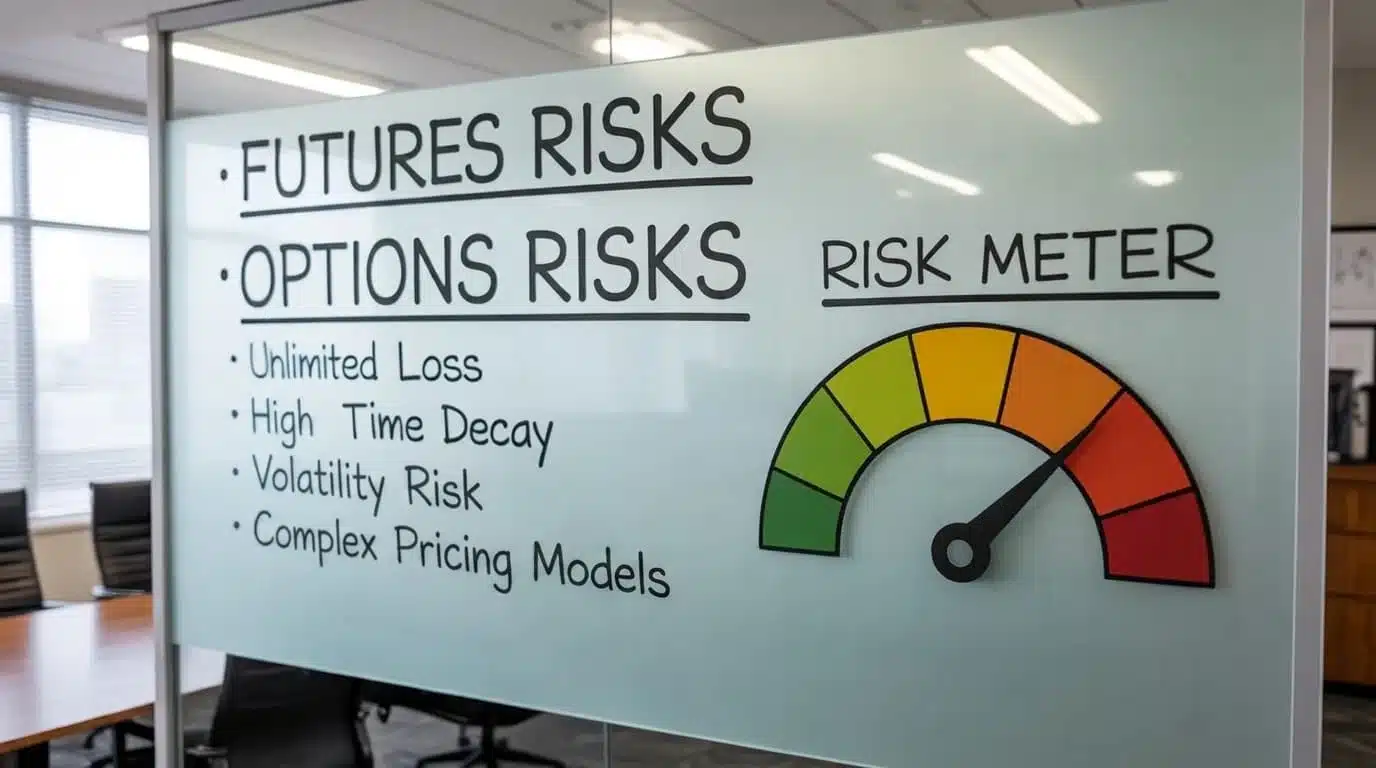
Every trader focuses on potential profits. The ones who last focus on potential losses first. Here is an honest breakdown of exactly what can go wrong on both sides.
Futures Risks
- Unlimited loss potential: no floor exists on how much you can lose; a single overnight gap can wipe out an entire account
- Margin calls: losses below the maintenance margin trigger immediate demands for additional funds or forced position closure
- Daily mark-to-market: losses are debited every evening, regardless of whether you have closed the position
- Overnight gap risk: markets can open significantly far from where they closed, creating instant losses before you can react
Options Risks
- Time decay (Theta): premiums erode daily; being right on direction but wrong on timing still results in a total loss
- Can expire completely worthless: 100% loss of premium paid is one of the most common outcomes for options buyers
- Implied volatility risk: buying options when IV is elevated means overpaying; a price move may not cover the premium cost
- Complex pricing: direction, time, and volatility all affect value simultaneously, making losses harder to predict or diagnose
Risk in both instruments is real and significant; the difference is that futures risk hits you immediately and without a ceiling, while options risk is quieter but equally capable of eroding your capital down to zero.
Common Mistakes Traders Make in Futures and Options
Avoiding these mistakes is cheaper than learning them the hard way through real losses. Here are the six most costly errors traders make repeatedly.
- Treating options as automatically safe: option sellers carry unlimited risk, identical to futures
- Overleveraging futures positions: always size against notional value, never margin deposited
- Buying options during high implied volatility: IV crush destroys the premium even when the direction is correct
- Misunderstanding contract size: one contract controls far more than most beginners ever realize
- Holding commodity futures to expiry: physical delivery is a real and expensive consequence
- Ignoring time decay on entry: being right on direction but wrong on timing still loses money
Knowing these six mistakes before placing your first real trade is the most valuable and cost-effective preparation any beginner trader can possibly do.
Futures vs Options: Which Should You Trade?
Neither instrument is universally better. The right answer depends entirely on your capital, risk tolerance, experience level, and what you are actually trying to achieve with the trade.
| Your Priority | Choose Futures | Choose Options |
|---|---|---|
| Capital to start | $12,000–$20,000 margin | $200–$500 premium only |
| Risk comfort | Unlimited downside, margin calls | Maximum loss fixed at entry |
| Market access | Near 24-hour deep liquidity | Standard market hours |
| Hedging need | Large commodity or index positions | Stock portfolio via put options |
| Income generation | Not available | Covered calls, cash-secured puts |
| Strategic range | Directional only | Multiple strategies, one market view |
| Account size | Large capital required | Smaller accounts, accessible entry |
Can You Use Both Together?
Yes, and many professional traders regularly do. A common approach: hold a futures position for core directional exposure while simultaneously buying an option as a hedge against a sudden adverse move.
The futures position provides the leverage and linear payoff; the option caps the catastrophic downside. Used together deliberately, they complement each other in ways neither instrument can achieve independently on its own.
The most honest answer: start with options, master leverage and risk, then graduate to futures when your capital, discipline, and understanding are genuinely ready.
Final Thoughts
Choosing between futures and options is not a one-time decision; it is something every trader revisits as their skills and capital grow. Futures deliver raw, unforgiving market exposure with no premium eating into returns. Options give you control, flexibility, and a defined worst-case number before placing the trade.
After covering both instruments in depth, I believe the biggest mistake beginners make is picking a side too early, before fully understanding what each demands. The futures vs options debate can only be answered with real screen time, not theory.
Start small, paper trade both, and let your own experience make the final call. Found this useful? Share it with a fellow trader or leave your questions in the comments.
Frequently Asked Questions
What is a Futures Rollover?
When a futures contract nears expiry, traders move their position to the next contract month. Missing rollover dates can result in unintended settlement or delivery.
Can Options be Exercised Early?
American-style options can be exercised at any time before expiry. European-style options only at expiry. Most US stock options are American-style, giving buyers full flexibility.
What are Micro Futures Contracts?
Smaller versions of standard futures, such as the Micro E-mini S&P 500, require only ~$1,400 in margin, compared with $14,000. Ideal for beginners seeking futures exposure.
Do Options Traders Need a Special Account Type?
Yes, brokers assign options approval levels (1–4). Level 1 allows covered calls only. Selling naked options requires Level 4 approval based on experience and net worth.