

I’ve watched AI reshape industries for years, but its impact on financial markets stands out.
AI arbitrage uses artificial intelligence to identify pricing gaps across markets faster than any human could process: the tiny inefficiencies where identical assets trade at different prices across platforms.
Think of it as a tireless digital scanner working through thousands of opportunities simultaneously, making split-second decisions. This is not just an upgrade to old trading methods. It changes the underlying logic of how markets get exploited.
In this piece, I’ll break down the mechanics of AI arbitrage, share compelling real-world examples, and help you understand both the genuine advantages and the risks.
If you’re an investor, entrepreneur, or just curious about how AI is changing commerce, this is worth understanding.
What Makes AI Arbitrage Different?
AI arbitrage is the practice of using artificial intelligence algorithms to identify and act on pricing inefficiencies across markets or platforms. What sets it apart from traditional arbitrage comes down to three things: speed, scale, and precision.
Conventional arbitrage relies on human traders manually spotting opportunities. AI processes massive datasets in milliseconds, executing trades before price gaps close. It learns from patterns and adapts strategies in real time. And it works across sectors that have nothing in common on the surface.
Financial markets use algorithms to trade stocks and derivatives. Cryptocurrency exchanges capitalize on volatile spreads. E-commerce platforms compare product prices instantly. Supply chain teams optimize procurement costs. Each application shares one goal: capturing price discrepancies with machine precision.
How AI Arbitrage Works
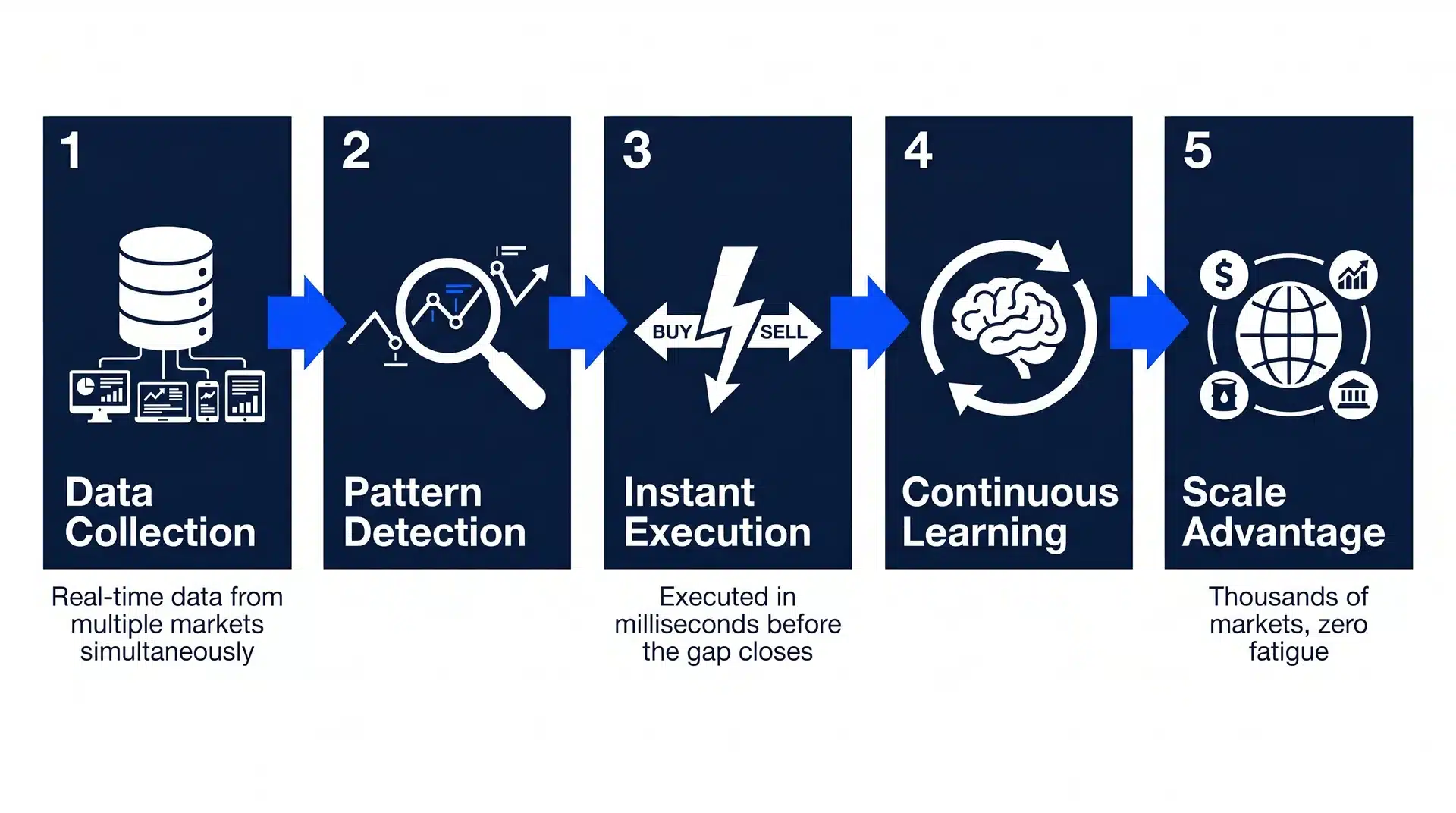
Understanding how AI arbitrage functions reveals why it has become such a powerful tool in modern markets. The process happens in five core stages, each executed at speeds humans simply cannot match.
- Step 1 (Data Collection): AI systems continuously gather real-time pricing data from multiple markets, exchanges, and platforms simultaneously.
- Step 2 (Pattern Detection): Advanced algorithms analyze millions of data points per second, identifying price discrepancies the moment they appear.
- Step 3 (Instant Execution): The system automatically executes trades or transactions within milliseconds, capturing profit before opportunities vanish.
- Step 4 (Continuous Learning): AI refines its strategies based on outcomes, improving accuracy and adapting to changing market conditions.
- Step 5 (Scale Advantage): While human traders monitor handfuls of opportunities, AI tracks thousands across global markets without fatigue.
This entire cycle, from detection to execution, occurs faster than you can snap your fingers, giving AI-powered systems an edge over manual trading methods that is almost impossible to close.
Never deploy AI arbitrage systems without thorough testing and risk limits. Automated execution means losses can accumulate as quickly as profits.
Types of AI Arbitrage
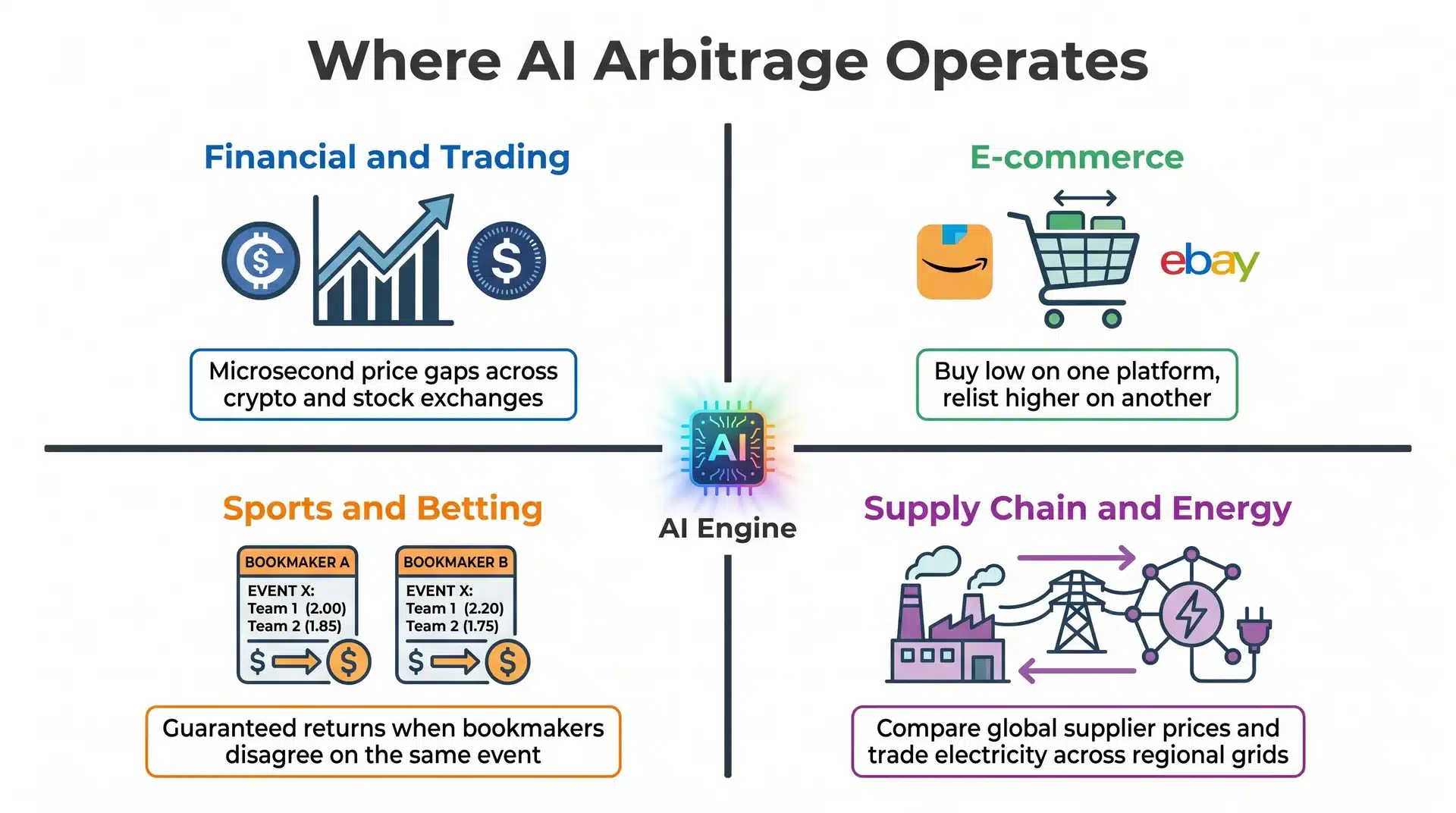
AI arbitrage spans multiple industries, each with distinct opportunities. Here is how different sectors use this technology to extract value from pricing inefficiencies.
1. Financial and Trading Arbitrage
AI algorithms monitor stock exchanges, forex markets, and cryptocurrency platforms around the clock, detecting microsecond price differences for identical assets.
When Bitcoin trades at $43,000 on one exchange and $43,150 on another, AI executes simultaneous buy-sell orders, pocketing the spread.
High-frequency trading firms run this approach thousands of times daily, capitalizing on fleeting opportunities that disappear within milliseconds across global financial markets.
2. E-commerce Arbitrage
Retailers face constant price fluctuations across online marketplaces. AI tools scan platforms like Amazon, eBay, and Walmart, identifying products that sell cheaper on one site than another.
Sellers then purchase inventory at lower prices and relist at higher rates, with the entire process automated. This extends to dropshipping models where AI manages inventory-free operations, adjusting pricing based on real-time competitor data and demand signals.
3. Sports and Betting Arbitrage
Bookmakers often set different odds for identical events, creating profit opportunities that exist regardless of outcome.
AI scans hundreds of betting sites simultaneously, calculating odds discrepancies that guarantee returns before the market corrects. If one bookmaker offers favorable odds on Team A while another favors Team B, AI places calculated bets on both sides, locking in risk-free profits before odds adjust.
4. Cross-Industry Applications
Beyond traditional markets, AI arbitrage optimizes supply chain procurement by comparing supplier prices across the globe. Energy markets benefit too, with AI trading electricity across regional grids where prices fluctuate hourly based on demand.
Advertising platforms also use arbitrage principles, buying ad space cheaply on one network and reselling at premium rates, maximizing campaign ROI through algorithmic efficiency.
Benefits of AI Arbitrage
The advantages of AI arbitrage explain its rapid adoption across industries. These are not marginal improvements over manual methods. In several areas, they represent a category difference.
- Lightning-Fast Speed: AI reacts in milliseconds, executing trades before human traders can even recognize an opportunity exists.
- Precision Accuracy: Algorithms eliminate human error and emotional bias, consistently identifying genuine arbitrage opportunities with mathematical certainty.
- Massive Scalability: A single AI system monitors thousands of markets, exchanges, and platforms simultaneously, something no team of traders could achieve.
- Micro-Profit Mastery: AI captures tiny price inefficiencies that individually seem insignificant but compound into substantial returns through volume and frequency.
- Relentless Operations: These systems work around the clock across global time zones, never needing sleep, breaks, or vacations while markets remain active.
Risks and Limitations of AI Arbitrage
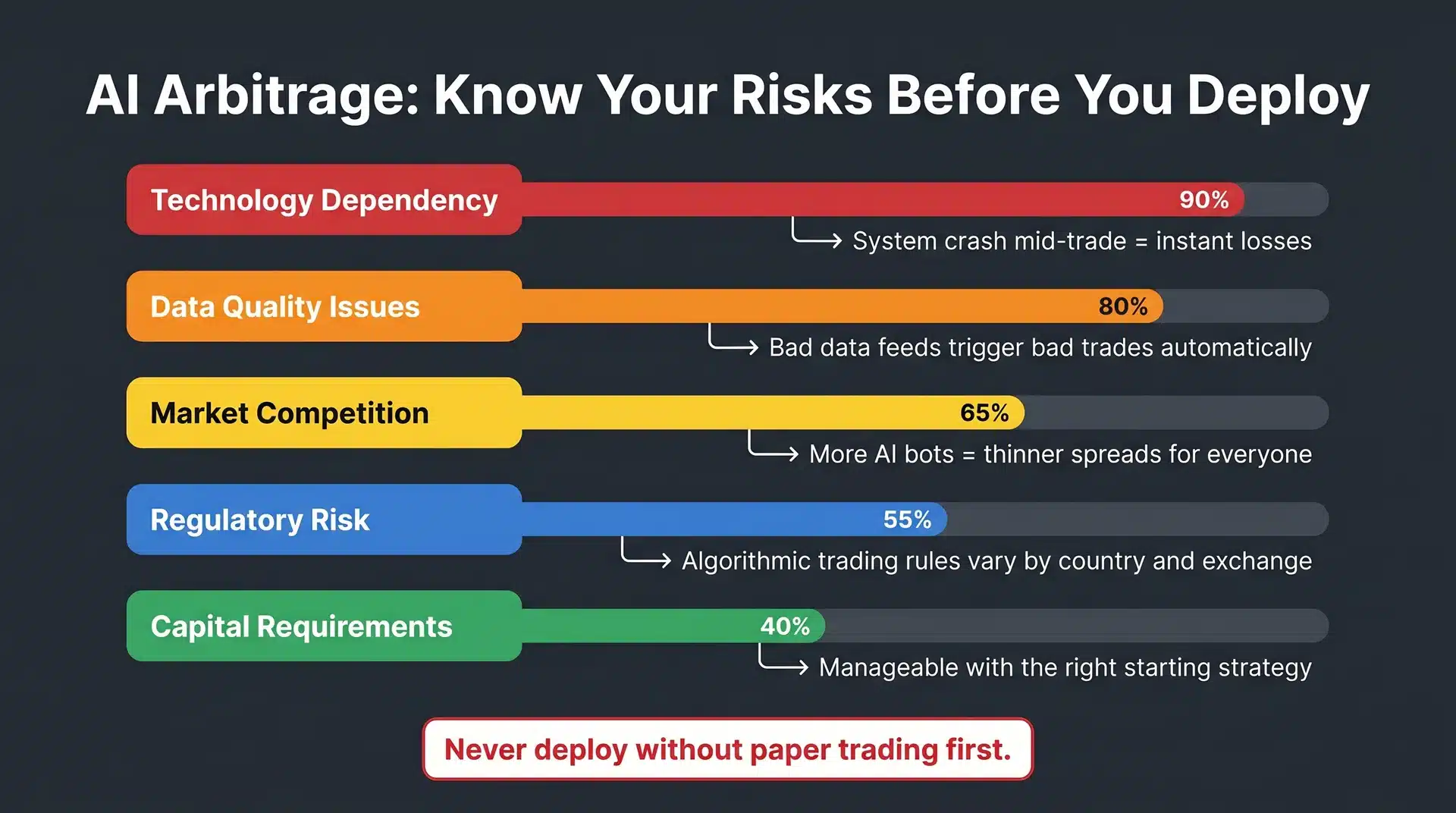
AI arbitrage carries real challenges. Understanding these risks helps you approach this technology with realistic expectations and proper safeguards.
| Risk | Description | Impact | Who’s Affected | Mitigation |
|---|---|---|---|---|
| Technology Dependency | System failures or connectivity issues | Missed trades, unexpected losses | All AI traders | Backup systems, redundancy |
| Market Competition | Too many AI systems are chasing the same opportunities | Shrinking profit margins | Smaller firms | Faster tech, niche markets |
| Regulatory Risks | Legal restrictions on algorithmic trading | Fines, trading bans | Institutional traders | Compliance monitoring |
| Data Quality Issues | Inaccurate or delayed data feeds | False signals, bad trades | Data-dependent traders | Multiple sources, validation |
| Capital Requirements | Large funds needed for meaningful returns | High entry barriers | Retail traders | Start small, reinvest profits |
These limitations do not eliminate the potential here, but they demand careful risk management in trading, solid infrastructure, and realistic capital planning.
Real-World Examples of AI Arbitrage
AI arbitrage is not theoretical anymore. It is actively reshaping markets across multiple sectors. Here are concrete examples of how this works in practice.
1. Crypto Arbitrage in Action
Cryptocurrency markets are well-suited to AI arbitrage due to fragmented exchanges and high volatility. AI bots monitor price differences between platforms like Binance and Coinbase.
When Bitcoin trades at $42,500 on one exchange and $42,680 on another, bots buy low and sell high instantly. These opportunities vanish in seconds, but AI executes hundreds of such trades daily, capturing spreads human traders would miss entirely.
Traders who also want to profit from falling prices can combine this with shorting crypto on the same exchanges.
2. Stock and ETF Arbitrage
Traditional financial markets contain pricing inefficiencies in derivatives and ETFs. AI algorithms on platforms like the New York Stock Exchange detect when an ETF’s market price diverges from its net asset value.
If an S&P 500 ETF trades below its underlying stocks’ combined value, AI simultaneously buys the undervalued ETF and shorts overvalued components. This statistical arbitrage requires processing vast real-time data at speeds only algorithms can achieve.
3. E-commerce Price Arbitrage
Retail arbitrage has become highly automated. AI algorithms continuously scan Amazon and eBay, finding products priced differently across platforms.
When electronics list for $150 on eBay but sell for $200 on Amazon, AI-powered sellers automatically purchase and relist at profitable margins. These systems factor in fees, shipping, and demand fluctuations, managing thousands of products simultaneously while maintaining profitability.
Each strategy carries real risks: exchange delays, market volatility, platform suspensions, and rapid value erosion. Always test with minimal capital and implement strict stop-losses before scaling.
Tools and Platforms for AI Arbitrage
Getting started with AI arbitrage requires the right technology stack. Here is a breakdown of popular tools and platforms that traders and businesses use to implement arbitrage strategies.
| Tool/Platform | Category | Pros | Cons |
|---|---|---|---|
| Alpaca | Algorithmic Trading | Commission-free trading, easy API integration, support for Python | US stocks only, limited to certain markets |
| QuantConnect | Algorithmic Trading | Multi-asset support, cloud-based backtesting, large community | Steeper learning curve, premium features are costly |
| MetaTrader | Algorithmic Trading | Industry standard for forex, extensive indicators, customizable bots | Complex interface, primarily forex-focused |
| TensorFlow | AI Data Analytics | Powerful pattern recognition, flexible, and strong documentation | Requires programming expertise, resource-intensive |
| PyTorch | AI Data Analytics | Intuitive design, excellent for research, dynamic computation | Smaller deployment ecosystem than TensorFlow |
| Crypto Trading Bots | Automation | 24/7 operation, fast execution, customizable strategies | Security risks; requires constant monitoring |
| E-commerce Bots | Automation | Automates repricing, monitors competitors, scales easily | Platform restrictions, potential account bans |
Choosing the right tools depends on your target market, technical expertise, and available capital. Many traders combine multiple platforms to build comprehensive arbitrage systems, and often pair them with swing trading strategies for steadier returns when pure arbitrage opportunities are thin.
Always start with paper trading or minimal capital. Test extensively in live conditions before scaling up. Never invest funds you cannot afford to lose, and implement strict stop-loss mechanisms to protect against runaway losses from system errors.
Frequently Asked Questions About AI Arbitrage
Is AI arbitrage legal?
AI arbitrage is legal in most jurisdictions, but the legality depends heavily on the specific strategy and market. Pure price arbitrage, buying an asset cheaply on one platform and selling it for more on another, is generally protected and accepted.
The legal grey zones appear in high-frequency trading on regulated exchanges, where some forms of algorithmic activity can be classified as market manipulation depending on intent and method.
Sports betting arbitrage is legal where the underlying betting activity is legal. Before deploying any automated trading system, it is worth consulting local financial regulations and the terms of service for each platform you plan to use.
How much money do you need to start with AI arbitrage?
The honest answer varies a lot by strategy. E-commerce arbitrage can technically be started with a few hundred dollars in inventory, though meaningful returns require more.
Financial and crypto arbitrage is more capital-intensive because the price spreads being captured are often fractions of a percent.
To make those spreads worth the effort after fees, most practitioners suggest a minimum of $1,000 to $5,000 for crypto arbitrage and significantly more for stock or ETF strategies.
Starting small is smart: test your systems thoroughly with money you can afford to lose before scaling up.
What is the difference between AI arbitrage and high-frequency trading?
High-frequency trading (HFT) is a subset of algorithmic trading focused on executing a very large number of orders at extremely fast speeds, often in microseconds.
AI arbitrage is a broader category that uses artificial intelligence specifically to detect and act on pricing inefficiencies across markets. Not all AI arbitrage qualifies as HFT: e-commerce price arbitrage, for example, runs on a much slower timescale.
Conversely, most HFT firms do employ arbitrage strategies as part of their approach, making the two concepts closely related at the professional level but distinct in scope.
Can AI arbitrage bots guarantee profits?
No, and you should be deeply skeptical of any service that claims otherwise. Pricing inefficiencies close fast, often within milliseconds, and as more AI systems compete for the same opportunities, spreads get thinner.
Technical failures, slippage, exchange fees, and sudden market volatility can quickly turn a profitable strategy into a losing one.
Legitimate AI arbitrage tools are probabilistic: they improve your odds and speed, but they do not eliminate risk. If someone is selling you a bot promising guaranteed daily returns, that is almost always a red flag.
What risks should beginners watch out for in AI arbitrage?
The most common trap for beginners is underestimating fees. Transaction costs, withdrawal fees, and exchange spreads can easily eat into or eliminate the profit margin you thought you identified.
A second major risk is data latency: if your pricing data is even slightly delayed, you may execute a trade based on an opportunity that has already closed.
Technology failures are also a real concern, as an automated system executing bad trades without human oversight can quickly accumulate losses.
Finally, watch out for platform restrictions; Amazon, eBay, and crypto exchanges all have rules against certain forms of automated trading, and accounts can be suspended without warning.
The Future of AI Arbitrage
AI arbitrage is positioned for significant growth across both financial and non-financial sectors. As markets become more interconnected, AI’s influence on price discovery and market efficiency will intensify.
Emerging technologies like blockchain and decentralized finance (DeFi) create new arbitrage opportunities with near-instant settlement times. Integration with IoT devices could enable real-time supply chain arbitrage. However, this evolution raises legitimate ethical concerns.
Regulators like the SEC are scrutinizing algorithmic trading for potential market manipulation and fairness issues. As AI systems grow more capable, ensuring transparency and preventing predatory practices becomes important for maintaining healthy, accessible markets for all participants.
Conclusion
AI arbitrage is a real and growing practice. It lets traders capture pricing inefficiencies at speeds and scales that no human team can match. The profit potential exists, but so do the risks: technology failures, regulatory scrutiny, and intense competition from other AI systems all demand careful planning.
Success depends on solid systems, quality data, and staying current with regulations that are still catching up to the technology. As markets continue evolving, staying informed is your most durable competitive advantage.
Have you experimented with AI arbitrage, or are you considering entering this space? What opportunities or concerns resonate most with you? Share your perspective in the comments below.